
Summary
Rule 43 application is the High Court’s fast, paper‑based route to protect spouses and children while a divorce is pending. It can award maintenance (spousal and/or child), a contribution to legal costs and interim care/contact arrangements, typically decided on affidavits with limited evidence and compressed timelines. Variation is possible under Rule 43(6) if circumstances materially change. Rule 43 orders are generally not appealable because they are interim; the usual remedy for changed circumstances is an application under Rule 43(6).
If your matter is based in Gauteng, you can also read our Johannesburg divorce, custody and Rule 43 advice page for broader guidance on interim relief, parenting disputes, and divorce strategy.
Quick answer (Rule 43 in South Africa)
Rule 43 application is a High Court process used during a pending divorce to obtain temporary relief – usually child/spousal maintenance, a contribution to legal costs, and interim care/contact arrangements. The court decides on concise affidavits and supporting documents (not a full trial). Outcomes turn on credible budgets and disclosure. If circumstances materially change, the order can be varied under Rule 43(6).
Rule 43 route map: what to prepare first
If you are deciding whether to bring a Rule 43 application, start with the remedy and the evidence. Rule 43 is strongest when the papers clearly connect the temporary relief requested to reliable financial disclosure, child-care facts and the immediate needs created by the pending divorce.
- For budgets, bank statements and supporting documents, use the financial disclosure and FDF guide.
- For interim maintenance and contribution to legal costs, see contribution to legal costs in divorce.
- If your divorce is in the Regional Court rather than the High Court, compare Rule 58 vs Rule 43 interim relief.
- If an existing interim order is being ignored, move to the Rule 43 enforcement and contempt route.
Rule 43 application route: applicant, respondent, variation or enforcement?
Most Rule 43 problems start with the wrong route. Before drafting, identify whether you are bringing the first application, opposing one, varying an existing order, enforcing non-compliance, or dealing with the Regional Court equivalent under Rule 58.
| Situation | Best next step | Useful SD Law route |
|---|---|---|
| You need interim maintenance, care/contact or a contribution to legal costs while divorce is pending. | Prepare a focused Rule 43 application with budgets, disclosure, child-care facts and a realistic draft order. | Financial disclosure / FDF guide and maintenance advice. |
| You have been served with a Rule 43 application. | Respond with credible figures, concise admissions/denials, and a workable alternative proposal. | Divorce attorney Cape Town and care/contact disputes. |
| An interim order no longer fits your income, parenting routine or child-care facts. | Consider a Rule 43(6) variation only where there is a material change in circumstances. | Rule 43(6) variation. |
| The other party is ignoring the order. | Move from negotiation to enforcement, contempt or practical compliance pressure. | Enforce a Rule 43 order. |
| Your divorce is in the Regional Court. | Compare Rule 58 and Rule 43 before assuming the High Court process applies. | Rule 58 vs Rule 43. |
If you are unsure which route applies, SD Law can assess the papers, the court forum, the urgency and the evidence before you commit to the wrong application.
What usually hurts a Rule 43 application
-
inflated budgets and inconsistent figures
-
selective disclosure (missing bank statements / liabilities)
-
long affidavits that try to turn Rule 43 into a “mini-trial”
-
dumping excessive annexures without structure
Table of contents
- Summary
- 1) What Rule 43 does and doesn’t do
- 2) Who should apply — eligibility and proof
- 3) The process (step‑by‑step, with timelines)
- 4) The evidence pack: what wins (and what judges don’t like)
- 5) Variation under Rule 43(6) — when and how
- 6) Enforcement and contempt of court — getting paid
- 7) Costs: contribution to legal fees & risk of punitive orders
- 8) Advanced strategy
- 9) Alternative and complementary legislation
- 10) Common mistakes (and how to avoid them)
- 11) Rule 43 – Frequently Asked Questions
- 12) Checklists
- People Also Ask
- Can I get my legal fees covered under Rule 43?
- What happens if my ex ignores a Rule 43 order?
- What is the difference between Rule 43 and Rule 58?
- Source notes
- Related articles:
1) What Rule 43 does and doesn’t do
Purpose. Rule 43 is an inexpensive mechanism to stabilise families during divorce litigation. Relief available includes:
- Maintenance while the divorce proceedings are pending (spousal and/or child)
- Contribution towards legal costs for pending divorce proceedings
- Interim care and contact arrangements for children
The courts emphasise speed, brevity and practicality.
Rule 43 is not a mini‑trial about the whole divorce. Papers must be concise; long-winded evidence is not welcome and can incur penalties.
2) Who should apply — eligibility and proof
To apply for a Rule 43 order you need to prove:
- A real interim need (e.g., housing, school fees, medical aid, day‑to‑day living) aligned to the marital standard of living,
- The other party’s means to contribute (income, assets, lifestyle).
The courts weigh needs vs. means, with the best interests of children paramount.
Your request for maintenance should be linked to realistic budget items and credible documents (salary slips, bank statements, medical aid statements, school invoices).
Related reading: Antenuptial Contracts, Property Division
3) The process (step‑by‑step, with timelines)
- Prepare applicant’s sworn statement (in the nature of a declaration) and Rule 43 notice.
- Serve; the respondent has 10 days to deliver a sworn reply (akin to a plea).
- Set‑down for argument; usually determined on the papers. No replying affidavits as of right; the court may call for more evidence under 43(5) if needed.
Timing reality check: The rule is designed for speed, but court rolls vary by division. Expect compressed timelines relative to ordinary motion practice; your division’s practice directives govern.
Need interim relief urgently?
If maintenance or parenting arrangements cannot wait for the divorce to finalise, we can advise on whether Rule 43 is appropriate, what evidence you need, and how to present a credible budget and disclosure pack.
4) The evidence pack: what wins (and what judges don’t like)
Helpful evidence:
- Full, frank financial disclosure (income, expenses, assets, liabilities)
- Child‑centred detail: actual costs, routines, schooling, health care
- Comparative budgets: pre‑separation vs. current vs. proposed
- Clean annexures: numbered, material, readable. Avoid duplicates
Red flags for a judge:
- Lengthy affidavits / irrelevant annexures. This can be seen as an abuse of the process
- Overwhelming the court or the other party with a last-minute mountain of documents. It’s frowned upon and can backfire
- Selective disclosure, i.e., only presenting certain pieces of evidence and hiding others. This could impact your credibility
Courts have increasingly struck out or penalised overlong, unfocused applications.
Financial Disclosure Forms (FDFs). Some divisions, notably Gauteng, require FDFs (under oath with supporting docs) in family matters / opposed Rule 43s via practice directives. Check your division’s directive; use the national FDF template as a baseline.
5) Variation under Rule 43(6) — when and how
You may vary an interim order where there’s a material change in circumstances (or genuinely new facts that were unavailable earlier). Mere dissatisfaction with the original order is not enough. Courts apply this test strictly.
If your dispute is not only about interim relief during divorce, but about whether the existing contribution can be lowered, see our guide on when child maintenance can be reduced in South Africa.
6) Enforcement and contempt of court — getting paid
Rule 43 orders are immediately binding. They cannot be appealed, and any attempt to reduce the amounts without reference to the court may incur penalties. Persistent non‑compliance is contempt of court. If you experience non-payment, you must show the order and demonstrate that there has been a wilful breach of the order.
Read more: Enforcing a Rule 43 Order
7) Costs: contribution to legal fees & risk of punitive orders
- Contribution to costs can be significant where the wealthier spouse litigates “at scale” (e.g., uses senior counsel).
- Abuse, e.g., lengthy evidence, risks adverse or punitive costs.
8) Advanced strategy
Be smart. Follow these tips to ensure success.
- Ensure credibility. Use candid disclosures, court‑ready schedules, consistent numbers and a restrained tone.
- Be reasonable. In your documentation, include a needs‑vs.‑means table, a standard‑of‑living analysis, and justifications for all numbers.
- Include personal factors, but do so sparingly. Show child routines, medical needs and disruption risk. Let the facts, in the form of reports, letters, statements, speak for themselves.
- Get the timing right. File when you have a genuine and provable need. Don’t file an over-inflated application prematurely. Judges are on the alert for mini‑trials.
9) Alternative and complementary legislation
- Rule 58 (Magistrate’s/Regional Court parallel): this legislation mirrors Rule 43 in the lower courts.
- The Maintenance Court (Maintenance Act) is for maintenance‑specific relief. Don’t use it to avoid a live Rule 43 order.
- Mediation (Rule 41A) and parenting plans may resolve care and contact matters faster.
Read more: Rule 43 vs Rule 58 (Magistrates/Regional Court)
Case-note context: for a practical example of interim maintenance and legal-costs relief in an abuse-linked divorce dispute, read our Rule 43 case note on maintenance and legal costs awarded to an abused wife.
Rule 43 (High Court) vs Rule 58 (Magistrates/Regional)
| Dimension | Rule 43 (High Court) | Rule 58 (Magistrates’/Regional Court) |
| Forum | High Court (Uniform Rules). | Magistrates’/Regional Court (Magistrates’ Courts Rules). |
| Purpose | Fast, summary interim relief pending divorce: child/spousal maintenance, interim care/contact, contribution to legal costs. | Parallel interim relief in lower courts: maintenance, care/contact, cost contribution. |
| How it’s decided | Paper-based on affidavits; court may call for limited further evidence under r 43(5). | Paper-based on affidavits; similar summary approach, with court controlling any further affidavits under r 58(5). |
| Respondent’s time to reply | Generally 10 court days to deliver a sworn reply. | Generally 10 court days to reply (see official Form 42/notice under r 58). |
| Set-down / notice | Registrar sets matter down for summary hearing on 10 days’ notice after papers close. | Set-down on ~10 court days’ notice (regional practice directives may refine logistics). |
| Appealability | Not appealable (interim nature; s 16(3) SCA). Remedy is compliance or variation under r 43(6). | Generally not appealable; blatantly unjust/erroneous r 58 orders may be reviewable in the High Court. |
| Variation | Rule 43(6): material change/new facts; wrong to detour to Maintenance Court. | Variation brought in the same forum under r 58; follow the lower-court route rather than shifting forums mid-stream. |
| Enforcement | Contempt available for wilful, mala fide non-compliance with interim order. | Contempt/standard enforcement remedies in Magistrates’ Court; principles mirror High Court in practice. |
| Financial disclosure | Gauteng: FDF exchange required per Family Court directives in opposed family matters (incl. r 43). | No national FDF rule; some regional directives guide disclosure bundles for r 58. |
| Costs & scale | High Court costs scale; contribution-to-costs awards common to ensure equality of arms. | Magistrates’/Regional Court costs scale; contribution-to-costs available under r 58. (Purpose mirrors r 43.) |
| Typical use-case | Higher-value/complex estates; matters already in High Court. | Local/less complex matters; divorces instituted in Magistrates’/Regional Court. |
10) Common mistakes (and how to avoid them)
- Launching before the divorce is truly “pending.” Rule 43 presupposes pending divorce proceedings. Courts have criticised applications launched before a summons for divorce has been issued. It is safer to issue the Rule 43 summons simultaneously or after the divorce summons has been served.
- Over‑pleading. Don’t turn your Rule 43 into a trial.
- Weak disclosure. If it is financially relevant, disclose it. Missing information can damage your credibility.
- Using the wrong forum for variation. Use Rule 43(6), not the Maintenance Court, to vary a Rule 43 order.
- Assuming you can appeal. You can’t. Rule 43 orders can be varied if circumstances change, but they cannot be appealed.
11) Rule 43 – Frequently Asked Questions
What can a Rule 43 order include?
Spousal/child maintenance while the divorce proceedings are pending, a contribution to legal costs, interim care/contact.
Within 10 days of the notice, via a sworn reply.
Usually no. Rule 43 is paper‑based; there are no replying affidavits unless the judge calls for more evidence under 43(5).
Yes. Apply under Rule 43(6) for a material change. You must bring new evidence.
No. Orders cannot be appealed. Rather apply for a variation of the order.
It can be enforced. Contempt of court may apply if you can prove non‑compliance, wilfulness and bad faith.
In Gauteng, yes (per practice directive). Other divisions vary, but full disclosure is often required by practice notes.
12) Checklists
Applicant – pack list
- Sworn statement (needs vs means)
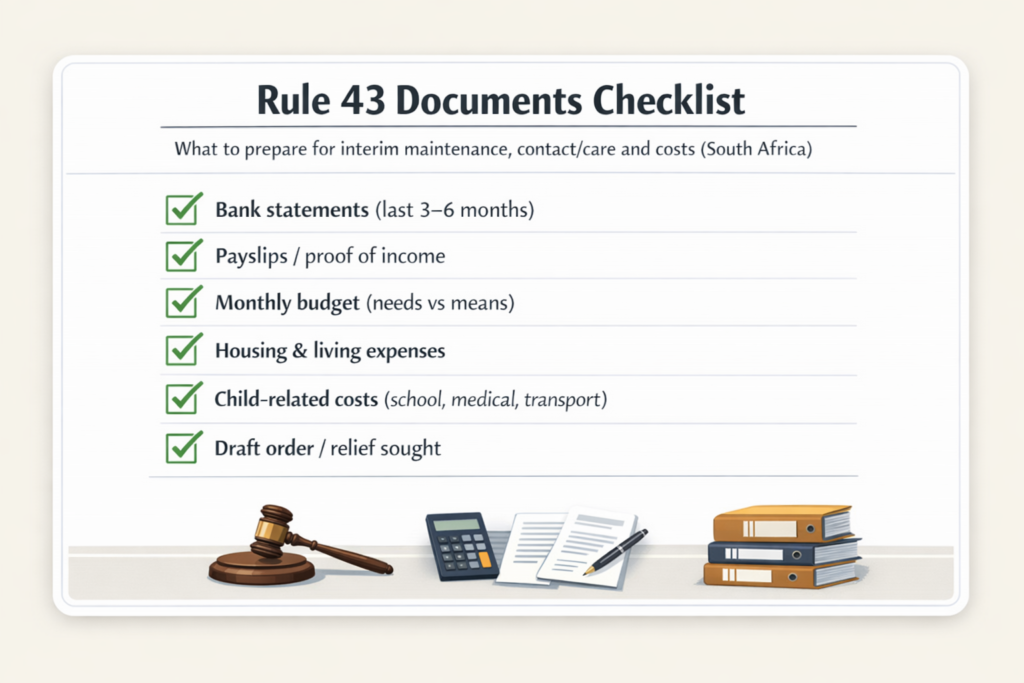
- Proposed draft order with line‑items
- Itemised monthly budget (you + children)
- Bank statements (6–12 months), payslips, tax docs
- Medical aid, school, transport, rent/bond proofs
- Any special‑needs costs; verified quotes
- FDF (if applicable in your division) + annexures
Respondent – response pack
- Sworn reply; point‑by‑point admissions/denials
- Comparative budget; corrected figures; audited affordability
- Full disclosure (bank/investment statements, liabilities)
- Alternative proposals (care/contact schedule; realistic maintenance)
- Evidence undermining excess / non‑essential claims
- If change hits later: prepare a 43(6) brief with updated docs
People Also Ask
How long does a Rule 43 application take?
Rule 43 is designed for speed. The respondent typically has 10 court days to file a sworn reply, and the matter is then placed on a summary roll in accordance with the division’s practice directives. In practice, turnaround varies significantly by division and roll congestion – your attorney should advise you on realistic timeframes for your court.
What documents do I need for Rule 43 in South Africa?
Courts expect concise, material evidence that proves needs and means.
Essential documents include:
- The applicant’s sworn statement (setting out income, expenses, children’s needs, and the relief sought);
- A budget or schedule of monthly expenses;
- Bank statements, salary slips, and proof of medical-aid or school costs;
- Supporting invoices or receipts; and
- Where required (notably in Gauteng), a Financial Disclosure Form (FDF) with annexures.
- Keep annexures numbered, readable, and limited to essentials—over-long “mini-trials” attract judicial censure.
Can I get my legal fees covered under Rule 43?
Yes. Rule 43 (1) (c) empowers the High Court to order a contribution to legal costs while a divorce is pending. The aim is equality of arms – ensuring the financially weaker spouse can litigate effectively. Courts consider each party’s means, the scale of litigation, and whether the contribution sought is reasonable and proportionate. Abuse of the process or inflated budgets can attract adverse cost orders, but a well-motivated, fact-based request is routinely granted where the other spouse has ample resources.
What happens if my ex ignores a Rule 43 order?
A Rule 43 order binds immediately. Ignoring it can trigger civil contempt proceedings. You must show (1) the existence of the order, (2) the respondent’s knowledge of it, and (3) wilful and mala fide non-compliance. The court can then impose suspended sentences, fines, or other coercive measures until compliance. Courts have repeatedly confirmed that Rule 43 orders are not appealable; the correct route for a genuine change in circumstances is an application under Rule 43(6). Self-help—like unilaterally reducing payments—is risky and often punished in costs.
What is the difference between Rule 43 and Rule 58?
Both rules provide interim maintenance and parenting relief pending divorce, but they apply in different courts.
- Rule 43: High Court; larger or complex estates; decided on affidavits only; variation via r 43(6); not appealable.
- Rule 58: Magistrates’/Regional Court equivalent; same relief categories; costs on lower-court scale; may be reviewable in the High Court if irregular.
Procedurally they mirror each other—each aims to deliver fast, paper-based interim justice—but practitioners must file in the forum where the divorce itself is pending.
Source notes
Key authorities confirming purpose, process, timelines, and enforcement include recent High Court judgments and DoJ forms: Western Cape/Eastern Circuit on purpose and non‑appealability; Gauteng and KZN on summary, affidavit‑based procedure; contempt and variation case law; Gauteng FDF directive and national FDF template. See judgments and directives cited throughout this guide.
Primary sources:
Speak to a Rule 43 attorney before the papers are drafted
Rule 43 applications are usually won or lost on evidence, proportionality and restraint. Before you issue or oppose an application, prepare the maintenance schedule, bank statements, children’s costs, contact proposal and legal-cost contribution evidence.
SD Law assists with interim maintenance, care and contact, contribution to costs and urgent divorce strategy. Request a call back for a focused assessment.
Related articles:
- New divorce laws in South Africa
- Rule 43 and Muslim Divorce
- Child & Spousal Maintenance
- Divorce mediation
- What Court has Jurisdiction in an International Divorce
Durban/KZN interim relief note: If a Durban divorce needs interim maintenance, care and contact, legal-cost contributions or urgent stabilising relief, see our Durban divorce and family-law support page for appointment-based guidance.