
Quick answer:
In South Africa, property division on divorce depends on your matrimonial property regime: in community of property, out of community of property with accrual, or out of community of property without accrual. Each system determines what assets are shared, how debts are allocated, and whether claims can be made against pensions, businesses, or growth during the marriage. The correct classification of assets – and proof – often determines the outcome.
If either spouse, a business, trust, pension or material asset is outside South Africa, property division should be planned as part of the wider international divorce strategy in South Africa. For the specialist asset route, see cross-border asset division.
Property disputes: contested or settlement-ready?
Quick answer: a divorce property dispute is settlement-ready only when both spouses understand the matrimonial property regime, disclose material assets and debts, and agree on how the estate, pensions, business interests and trusts will be dealt with. If information is missing, the matter is not truly uncontested.
- Confirm the marriage regime: in community, out of community with accrual, or out of community without accrual.
- Use disclosure tools early, including the Financial Disclosure Form where applicable.
- Check linked claims carefully: accrual in divorce, retirement funds and divorce, family trusts, business interests and debt allocation.
- If support or legal costs cannot wait, consider Rule 43 interim relief while the main property dispute is prepared.
- If the parties can agree after disclosure, reduce the agreement to a precise settlement agreement before the decree is granted.
Primary sources: the Matrimonial Property Act 88 of 1984 and the Divorce Act 70 of 1979.
Durban and KZN divorce property division: what to prepare first
Quick answer: in a Durban, Umhlanga, Ballito or wider KwaZulu-Natal divorce, the property issue should be mapped before settlement talks begin. The first questions are: what matrimonial property regime applies, what assets and debts exist, what proof is available, whether any pension interest must be dealt with in the divorce order, and whether business or trust assets need valuation or disclosure steps.
For appointment-based advice where property division, accrual, pension interests, business assets or trusts form part of a Durban divorce, see our Durban divorce and family-law page. The aim is to identify the financial issues early enough to settle safely, or litigate with a proper evidence record if disclosure is refused.
Durban property-division issue map
| Issue | What must be tested | Related SD Law resource |
|---|---|---|
| Accrual calculation | Commencement values, excluded assets, current estate values, liabilities and whether the numbers are supported by documents. | Accrual in divorce |
| Pension interests | Fund name, member details, exact percentage or amount, date of divorce and fund-friendly order wording under the Divorce Act. | Retirement funds and divorce |
| Business or professional practice | Valuation, income extraction, loan accounts, goodwill, tax consequences and whether disclosure is complete. | Financial disclosure in divorce |
| Trust assets | Whether the trust is genuine estate planning, a family asset-holding structure, or being used to obscure control or value. | Family trusts in South Africa |
| Home, bond and occupation | Whether the home should be sold, transferred, retained temporarily, or dealt with alongside maintenance and children’s stability. | Rule 43 interim relief |
| Settlement or post-marriage correction | Whether a settlement, postnuptial agreement or section 21 application is needed for future-proofing after marriage. | Postnuptial agreements |
Documents to collect for a Durban property-division consultation
- antenuptial contract, marriage certificate and any prior settlement drafts;
- title deeds, bond statements, municipal accounts and property valuations;
- bank, investment, pension, retirement-annuity and policy statements;
- company financials, trust deeds, loan-account schedules and tax records where relevant;
- vehicle finance, credit agreements, suretyships and debt schedules;
- proof of inheritances, donations, excluded assets or commencement values;
- evidence of asset movement, dissipation, non-disclosure or unusual transfers.
Legal context: the Matrimonial Property Act governs the core property-regime and accrual framework. Pension interests in divorce are dealt with under the Divorce Act, particularly section 7(7) and section 7(8), so the wording of the divorce order matters.
FAQs: property division in a Durban divorce
Can we settle property division before issuing divorce proceedings?
Often, yes, but only if disclosure is sufficient and the agreement is drafted so it can be implemented and made an order of court. A vague agreement can create enforcement and transfer problems later.
What if my spouse will not disclose assets or business information?
Then the matter may not be settlement-ready. A firmer disclosure strategy may be needed, including financial disclosure requests, valuation evidence and, where appropriate, interim relief for maintenance or legal costs.
Do pension interests need special wording in the divorce order?
Yes. The fund should be identified correctly and the order must state the assignable portion clearly. Poor wording can delay or prevent payment by the fund administrator.
1) Introduction — the real question after “I want a divorce.”
Every divorce tells two stories: one emotional, one financial. Most people know that they’re divorcing long before they understand how property will be divided. Yet that single question — “who gets what?” — determines whether you rebuild quickly or spend years in litigation.
At SD Law | Simon Dippenaar & Associates Inc., we translate complexity into clarity. This guide explains, in plain English, how property is divided under South African law, what rules govern homes, pensions, businesses, and debt, and why clarity = peace.
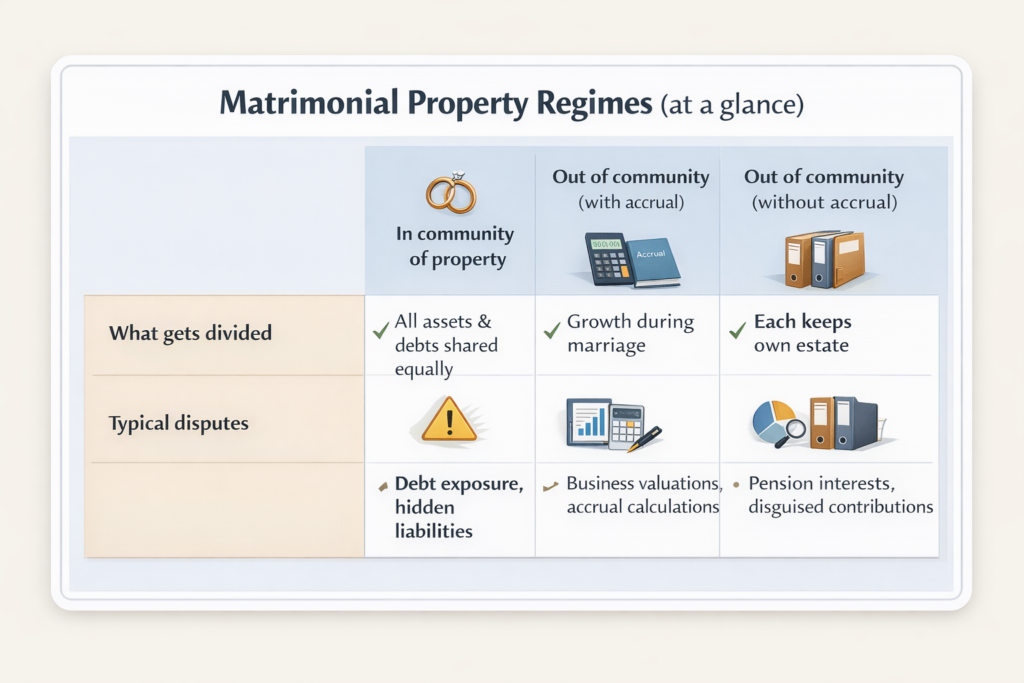
Matrimonial Property Regimes (at a glance)
| Regime | What gets divided | Typical disputes |
|---|---|---|
| In community of property | All assets & debts shared equally | Debt exposure, hidden liabilities |
| Out of community (with accrual) | Growth during marriage | Business valuations, accrual calculations |
| Out of community (without accrual) | Each keeps own estate | Pension interests, disguised contributions |
2) Matrimonial property regimes — the foundation of division
Before anything else, identify your marital property system, because every calculation flows from it.
In community of property (default)
If you didn’t sign an antenuptial contract (ANC), everything forms one joint estate. Each spouse owns an undivided half. On divorce, the estate is split 50/50. Simple, but risky — one partner’s debt becomes the other’s problem.
Out of community of property without accrual
Each spouse keeps their own estate. No sharing of growth or liabilities. Clean, but potentially unfair if one spouse sacrificed a career for family.
Out of community of property with accrual
Each starts with a separate estate, but shares the growth during marriage. On divorce, the spouse whose estate grew more pays half the difference to the other (Matrimonial Property Act s 3).
Read more: Antenuptial Contract (ANC) South Africa.
Full overview: Divorce in South Africa – Complete Guide.
3) How courts calculate division of property
When settlement fails, courts (or mediators) broadly follow this flow:
- Confirm the property regime.
- Establish each estate’s value (date of summons or as agreed).
- Subtract debts and excluded assets (e.g., inheritances excluded by law/contract).
- Apply the regime rules (50/50 split or accrual formula).
- Record the outcome in a consent paper or court order.
Simple accrual example: If Spouse A’s estate grew by R2 000 000 and Spouse B’s by R1 000 000, A pays B R500 000 (half the difference).
4) The marital home — sale, transfer or buy-out
The home is often the most emotional and expensive asset. Who stays there is not automatically who owns it.
- While the case runs: The High Court can grant temporary occupation and maintenance under Rule 43.
- After the decree: Options include sale and split of proceeds, or transfer to one spouse (with bond assumption and a settlement payment).
- Where minor children live in the home: Courts balance stability for children with financial fairness.
Learn more: Rule 43 interim orders (use/occupation, maintenance)
Also useful: Contribution to legal costs (Rule 43)
5) Pensions, retirement funds & policies and divorce
A pension is often the largest asset after the home. Under the Divorce Act s 7(7)–(8), a spouse’s pension interest may form part of the patrimonial benefits to be dealt with on divorce.
- Your divorce order must name the fund and the exact share (e.g., “50% of the member’s pension interest as at date of divorce”).
- The fund transfers that amount to the non-member spouse (tax effects managed under the Pension Funds Act; tax occurs when withdrawn, not on transfer).
- GEPF/RAF and certain funds require precise wording and forms.
We draft fund-friendly order wording so administrators don’t reject it and delay your payout.
Read more:
6) Businesses, trusts & hidden assets
When a business is a spouse’s primary asset, an independent valuation protects both parties. We brief forensic accountants to analyse financials, goodwill and tax.
- Trusts: If a family trust is used to shield assets, courts may “pierce the trust veil” where justice demands.
- Disclosure: Rule 35 requires full financial disclosure. Non-disclosure invites cost sanctions and, in serious cases, contempt findings.
Learn more:
7) Debts & liabilities — the forgotten half
Divorce isn’t only about splitting assets; it’s about untangling liabilities.
- In community of property: All debts are joint; creditors may pursue either spouse.
- Out of community: Each spouse is responsible for their own debts.
- Suretyships: Banks can still hold you responsible unless sureties are cancelled.
- After decree: Close joint credit lines, update insurance and stop orders.
See: Financial consequences of divorce
8) Settlement agreements & Rule 43 protection
Most divorces end with a settlement agreement (consent paper) that sets out property division, maintenance and child arrangements, then becomes a court order (Divorce Act s 7).
If you can’t agree interim terms, apply for Rule 43 relief (temporary maintenance, use of the home, contribution to costs). It’s designed for speed — not revenge.
“Clarity is cheaper than conflict.”
Simon Dippenaar
For a full overview see: Divorce in South Africa – Complete Guide.
9) Tax implications & transfer costs
- Capital gains tax: Transfers under a divorce order can qualify for roll-over relief between spouses.
- Transfer duty: Exempt when the marital home is transferred to a spouse in terms of a divorce order (per SARS guidance).
- Timing: Update title deeds and municipal accounts promptly to avoid penalties.
- Retirement funds: Transfer to the non-member spouse; tax arises on withdrawal, not on transfer.
10) Practical steps before and after divorce
- Collect documents: Title deeds, policy statements, pension values, bond statements, valuations.
- Get valuations: Property/business appraisals ensure fair division.
- Consult early: Don’t move or sell assets before advice — it can backfire legally.
- Secure interim orders: If cash-flow is blocked, seek Rule 43 relief.
- After decree: Update your will and beneficiaries immediately.
Complex estates, businesses, or pensions?
Property division disputes often turn on valuation evidence and disclosure. We assist clients in structuring and litigating these claims as part of divorce proceedings.
📞Book a confidential strategy consult.
🎥Watch: Divorce Process & Costs — SD Law
11) What courts focus on in property division disputes
-
Documentary proof of ownership and value
-
Timing of asset acquisition (pre- vs post-marriage)
-
Credibility of financial disclosure
-
Whether assets were deliberately concealed or dissipated
Frequently Asked Divorce & Property Division Questions
It depends on your property regime and whose name is on the deed. While the case runs, Rule 43 can grant temporary occupation; the final order or consent paper then governs ownership.
Each spouse keeps their own estate. The spouse whose estate grew more pays half the difference (the accrual) to the other.
Yes. Pension interests form part of division and are transferred to the non-member spouse under s 7(8) (with correct fund wording).
In community: you share liabilities. Out of community: each handles their own debts (subject to suretyships you signed).
Weeks if you agree and values are clear; months if valuations and interim orders are needed.
Conclusion — divide well to move forward
Divorce doesn’t end everything — it resets the rules. When you understand how property is divided, you avoid the costliest errors: secrecy and delay.
Contact SD Law Family Attorneys
More info on our divorce attorney services in Cape Town.
Watch our Divorce video series on Youtube.
Related reading
- Post-separation abuse is not just “high-conflict divorce”
- Vary a divorce order
- Unmerging your money after a divorce
- Divorce in later life
- Dividing luxury items in divorce
- Hidden assets in divorce
- Married out of community of property with accrual?
- New court ruling has massive implications for marriage and divorce in South Africa
- Cross border asset division
Reviewed by Simon Dippenaar (Attorney). Updated 2 June 2026.
Disclaimer: This guide is general information, not legal advice. For advice on your facts, consult our attorneys.