
TL;DR (Quick answer)
- A foreign divorce can be valid in South Africa, but recognition depends on jurisdiction, authenticity, and finality.
- Problems usually show up when you try to remarry, deal with property in South Africa, or manage children across borders.
- The safest approach is to treat foreign divorce recognition as a documentation + jurisdiction exercise, not a “common sense” assumption.
Quick answer
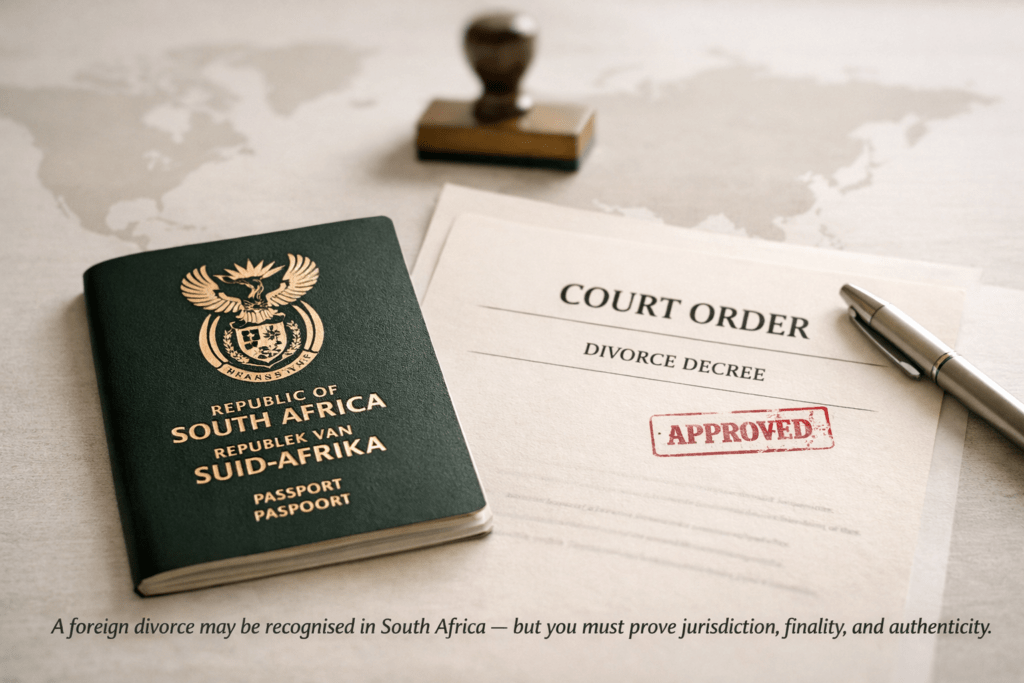
A foreign divorce can be valid in South Africa, but recognition depends on where you were domiciled or resident, whether the foreign court had proper jurisdiction, and whether the divorce order is authentic and final. Problems arise when people assume “I’m divorced overseas so South Africa automatically accepts it” — then later discover complications with remarriage, property, maintenance, or child arrangements.
This page is general information, not legal advice. International matters are fact-specific. The goal is to help you identify the correct next step.
Foreign divorce order, new South African divorce or service abroad?
Do not mix up three different problems. Recognition of an existing foreign divorce order is different from issuing a new South African divorce, and both are different from serving a summons on a spouse overseas.
| Your issue | Use this route |
|---|---|
| You already have a foreign divorce order | Stay on this page and prepare the recognition documents. |
| You still need to divorce in South Africa | Start with our international divorce lawyer route for jurisdiction, service and strategy. |
| Your spouse is overseas and must receive the summons | Use the service abroad / edictal citation guide before assuming the matter is simple. |
| Property, pension interests, children or maintenance remain in South Africa | Check the divorce order against South African enforceability, property division, care and contact and maintenance. |
1) Why recognition matters in South Africa
Recognition matters because it affects:
- Your legal marital status in South Africa (including remarriage)
- The enforceability of property division and maintenance outcomes
- Parental responsibilities and rights, care & contact, and cross-border relocation risk
- Whether court processes (including service of documents) were valid
In short: the divorce order is not just “paperwork” — it can control what you can legally do next.
2) The key legal question: did the foreign court have jurisdiction?
When assessing whether a foreign divorce is valid in South Africa, the central question is whether the foreign court had a proper legal basis to grant the divorce.
South African private international law typically looks at connecting factors such as:
- domicile / habitual residence
- ordinary residence
- genuine connection to the foreign forum
- due process (proper notice and participation opportunity)
If you were not properly connected to the foreign forum, recognition can become complicated — even if the divorce felt “real” in practice.
3) Document checklist: what you usually need
If you want a foreign divorce recognised (or want to avoid future disputes), gather:
- A certified copy of the final divorce order (and reasons, if relevant)
- Proof that the order is final (no appeal pending)
- Your marriage certificate (South African or foreign)
- IDs / passports
- Any settlement agreement made an order of court (property, maintenance, parenting terms)
- If there are children: proof of residence, school details, travel history, passports, and any consent arrangements
Practical tip: If you cannot prove finality and authenticity, recognition becomes slow, costly, and uncertain.
4) Common traps we see
Trap A: “We did a quick online divorce overseas”
Some “online” divorces are not recognised because jurisdiction and due process are unclear.
Even where the divorce is valid, the documentation often isn’t strong enough to prove recognition when it matters.
Rule: Speed without proper jurisdiction/documentation is a false economy.
Trap B: One spouse moves back to South Africa and assumes the divorce follows
The foreign divorce may be valid — but the consequences often still need careful treatment in South Africa, especially where there are:
- assets in South Africa
- pension interests
- maintenance disputes
- children living in (or travelling to) South Africa
Rule: Recognition is not the same thing as a practical, enforceable plan.
Trap C: International service of process is ignored
If you need to sue or enforce something across borders (or in South Africa against a spouse overseas), service may require formal steps.
Depending on the country, this may involve:
- treaty-based service (where applicable),
- letters of request, or
- other formal methods required by the foreign jurisdiction.
Mistakes can invalidate the process — and cause expensive delays.
5) Children: the invisible international risk
If there are children and one parent is moving across borders, you must treat:
- care and contact arrangements
- relocation and travel consent
- passport controls and consent letters
- the risk of cross-border disputes
South Africa participates in international frameworks dealing with cross-border child matters, and the Central Authoritysystem can become relevant in certain disputes.
If children are involved, do not treat this as a “paperwork problem.” Treat it as a strategy problem.
6) When to get legal help immediately
You should consult urgently if:
- you want to remarry and there is any uncertainty
- there are assets in South Africa (property, pension interest, business interests)
- the other spouse is overseas and uncooperative
- there are children and international travel/relocation is on the table
- you suspect the foreign divorce process was not “proper” (jurisdiction or notice issues)
Speak to an international divorce lawyer
If you tell us:
- where the divorce happened,
- where each spouse lives now, and
- whether there are children or South African assets,
we can advise on:
- recognition and documentation
- cross-border process steps
- how to secure enforceable arrangements in South Africa
- how to avoid traps that cause delays and unnecessary litigation
Speak to an international divorce lawyer at SD Law.
FAQ
Not always. A foreign divorce can be recognised, but recognition depends on jurisdiction (your connection to the foreign court), proof that the order is final and authentic, and whether due process was followed.
Recognition usually involves proving the divorce order is final and authentic, and that the foreign court had proper jurisdiction. The correct approach depends on the country, your residence/domicile, and whether children/assets are involved.
Typically: a certified copy of the final divorce order, proof it is final (no appeal), your marriage certificate, IDs/passports, and any settlement/parenting orders made by the foreign court.
Often yes — but only if the foreign divorce is recognised and your marital status is legally clear. If there’s uncertainty, get advice before making life decisions based on assumptions.
You may still be able to proceed, but cross-border service and enforcement steps must be handled correctly. Poor service can invalidate proceedings or cause major delays.
Sometimes foreign orders are recognised, but cross-border child arrangements and enforcement can be complex. If children are involved, treat this as a strategy issue, not just paperwork.
Some countries use treaty-based service mechanisms for serving legal documents abroad. Whether it applies depends on the countries involved. If service is wrong, proceedings can be set aside.
It depends on the countries involved, whether documents are in order, whether the other party cooperates, and whether children/assets are involved. Clean documentation is the fastest lever you control.
Suggested reading
- International divorce lawyer
- Child custody lawyer
- Divorce process in South Africa
- Uncontested divorce South Africa
- Foreign divorce order in South Africa
Further reading
- Divorce Act 70 of 1979 (DoJ PDF): https://www.justice.gov.za/legislation/acts/1979-070.pdf
- Children’s Act landing page: https://www.gov.za/documents/childrens-act
- HCCH — South Africa Central Authority: https://www.hcch.net/en/states/authorities/details3/?aid=123
One last practical note
If your foreign divorce touches South African assets or children, don’t wait until a crisis (remarriage, sale of property, relocation dispute) forces the issue. Fix the documentation and strategy early.