
The urgent eviction timeline under PIE section 5 depends on urgency, court roll pressure, correct service, and the quality of the evidence pack. The fastest matters are the ones prepared properly upfront. The slowest are the ones where urgency is claimed but not proven, or where service and respondent details are defective.
This 2026 guide explains what to expect, what drives costs, and the most common delays that derail urgent eviction applications.
This is general information, not legal advice for your specific facts.
Quick answer: how long does an urgent eviction take?
In truly urgent matters with strong evidence and correct service, the process can move quickly. In practice, delays often arise from court roll congestion, service requirements, respondent identification problems, and incomplete papers. “Urgent” is not a guarantee of speed — proof and procedure determine the pace.
What usually determines the urgent eviction timeline?
- Strength of urgency: whether the papers objectively prove imminent harm.
- Evidence pack quality: photos, affidavits, incident logs, proof of ownership.
- Service: whether papers are served correctly and timeously.
- Respondent complexity: unknown occupiers, large groups, vulnerable persons.
- Court roll pressure: available hearing slots and judicial availability.
- Opposition: whether the matter is opposed and how substantial the defence is.
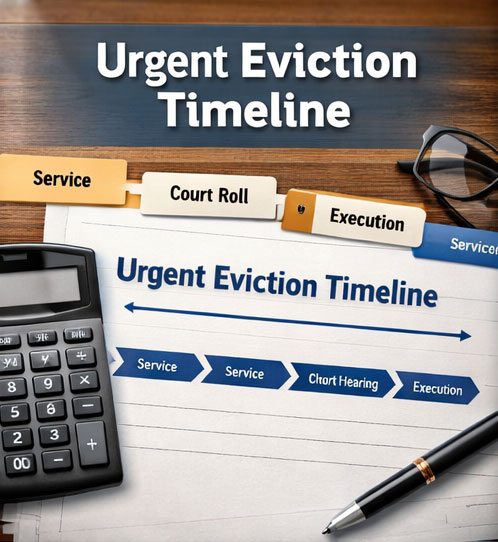
Timeline stages (high-level)
- Preparation: evidence pack + chronology + affidavits + relief drafted.
- Issue and service: filing and service on the occupiers (and other required parties where applicable).
- Hearing: court considers urgency, just and equitable factors, and practical implementation.
- Order and execution: if granted, implementation is carried out lawfully via the sheriff (often with SAPS support where appropriate).
Urgent eviction cost: what drives legal fees?
Urgent eviction costs vary by complexity and urgency. You are paying for rapid preparation, affidavit drafting, evidence assembly, service strategy, and court work. Fees increase when:
- There are many occupiers or unknown occupiers.
- The matter involves safety risk, damage, or organised occupation.
- Evidence is fragmented and must be reconstructed.
- Service is complex and requires multiple attempts or court-directed methods.
- The application is opposed with substantive affidavits.
Common delays (the real reasons “urgent” becomes slow)
- Weak urgency: no objective evidence of imminent harm, urgency created by delay.
- Service problems: defective service, wrong addresses, poor proof of service.
- Wrong respondents: failure to cite occupiers correctly or describe unknown occupiers properly.
- Poor papers: vague relief, missing annexures, unclear chronology.
- Opposition: disputes of fact that require additional affidavits or argument.
How to speed up an urgent eviction (what actually works)
- Build a clean chronology and evidence pack before launching.
- Use witness affidavits (security, neighbours, managing agents) to corroborate harm.
- Make service strategy realistic and compliant.
- Draft relief that is practical and enforceable.
Use this evidence pack guide: urgent eviction checklist.
When urgent eviction is not the right tool
If urgency cannot be proven, the court may strike the matter or direct it into ordinary PIE eviction proceedings. If your matter is not truly urgent, start here: evictions in South Africa.
Next step: the main urgent eviction order guide
For the full requirements and how the PIE section 5 test is approached, start here: urgent eviction order.
For general official information, see: justice.gov.za.