
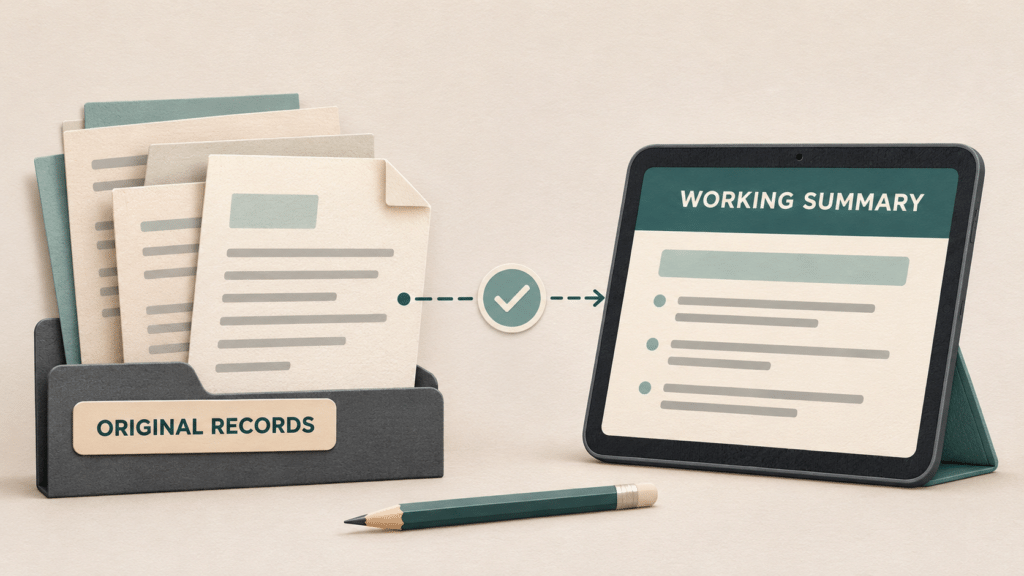
AI can help organise a South African divorce file. It can arrange dates, group expenses and turn a long message exchange into a readable chronology. But a summary does not, by itself, establish who created the records, whether they are complete or whether its conclusions are correct.
The risk is not limited to an obviously fake image. A genuine document can acquire the wrong meaning when a tool turns it into a confident account of what happened.
Consider a hypothetical example. A bank statement contains an R8,000 credit. You ask an AI tool to summarise the financial records. Its report calls the entry “undisclosed monthly income”. The presentation is clear. The arithmetic balances. Yet the most important step—the description of that money—has not been established.
Before that sentence becomes an allegation in a letter or affidavit, it needs a source check.
A bank entry and a conclusion are different
The statement may establish that money entered an account. On its own, it may not establish whether the amount was salary, a refund, a loan or a transfer between accounts.
In our example, suppose a second statement shows a matching debit from an account that appears to belong to the same person. That suggests an internal transfer, but account ownership and transaction details still need checking. If confirmed, the credit should not simply be counted again as a new salary payment. The source of the money in the first account may still need investigation.
| Record or statement | What it establishes or claims | What still needs checking |
|---|---|---|
| Original statement records an R8,000 credit | Money entered that account | Its source, purpose and surrounding transactions |
| AI summary calls it monthly income | The tool has classified the entry | Whether the records support either “monthly” or “income” |
| Second statement shows the matching debit | A possible transfer between the two accounts | Account ownership and whether the entries genuinely match |
| Draft allegation says income was concealed | A serious conclusion is being advanced | The factual basis for both the income classification and concealment |
This does not prove that the person has no other income. Nor is “not salary” a reason to leave the transaction out of the material your lawyer needs. The point is to describe the record accurately before deciding its significance.
An error in an AI summary should prompt a correction to the summary—not an alteration to the bank statement.
The same mistake can happen with a message
Suppose a message says: “I could consider paying R8,000 if we agree which costs it covers.” A summary that says “Your spouse agreed to pay R8,000 maintenance” removes the condition and adds certainty.
Those are different propositions. The original wording, the surrounding exchange and any later response matter. An AI-generated sentence should not replace them.
The problem here need not be a deepfake. It may be an ordinary summarisation error: a condition omitted, two speakers confused or an uncertain statement presented as settled.
What South African evidence law actually asks
Electronic material is not automatically excluded from court. Section 15 of the Electronic Communications and Transactions Act prevents rejection merely because the evidence is a data message, and addresses original-form objections where it is the best evidence reasonably obtainable. The section also directs attention to reliability, integrity and identification of the originator when assessing weight.
That is different from saying that every screenshot proves its contents, or that possible AI manipulation makes every electronic record inadmissible.
Hearsay is a separate issue. Depending on what a message is offered to prove and whose credibility matters, section 3 of the Law of Evidence Amendment Act may require consideration. There are statutory routes for admitting hearsay; putting another person’s statement into a polished AI summary does not resolve that question.
You do not always need a forensic expert
In Ackerman v Amaning and Another, decided on 7 October 2026, the Supreme Court of Appeal considered the authenticity of WhatsApp material. The recipient gave evidence, retained the messages on his phone and could make them available for verification. Expert evidence was unnecessary on those facts, where his evidence was not meaningfully challenged.
This was not an AI or divorce case. It nevertheless illustrates why a sensible response is neither “trust the screenshot” nor “hire an expert for every message”. Your lawyer should identify the real dispute and the evidence needed to address it. An AI detector’s score should not be presented as conclusive proof that somebody fabricated a record.
Give each important claim a route back to its source
A useful working sheet separates the record from your interpretation. For each material statement, record:
- The proposed claim: what you intend to say happened.
- The source: the file, page, transaction reference or message timestamp.
- The status: source fact, working inference, disputed allegation or unknown.
- The check still required: the missing record, calculation, explanation or person who can assist.
For the R8,000 example, a responsible working note might read: “Credit appears to match a transfer from another account held by the same person. Check both statements and account ownership. Do not describe it as salary on this entry alone.”
Keep unknowns visible. If the source does not identify the payer or explain a transaction, write that down. Asking a tool to fill the gap with a plausible story does not fill the evidential gap.
Keep original records separately from summaries, calculations and notes. Make the distinction obvious in the filenames and on the documents. If you use AI to extract amounts or dates, check the material entries against the originals and retain enough information to explain the corrections.
Organisation does not replace disclosure or legal judgment
An AI spreadsheet is not a substitute for the financial information required in your particular proceedings. Use our financial-disclosure guide to understand that separate task, and obtain advice about the procedure that applies to your court and matter.
Only use records you hold lawfully. Do not use another person’s login or device without appropriate authority. Before uploading bank statements, children’s information or private communications to an AI service, agree a secure way of working with your lawyer. Our approach to ethical AI use and legal judgment explains why accountability stays with people.
Before signing an affidavit, identify the source of each material assertion with your lawyer. A tool’s first-person wording does not give you personal knowledge of an event.
Bring the records as well as the summary
If you have used AI to prepare your divorce file, tell your attorney what it did. Bring the source documents, the working summary and the points you cannot yet verify. Do not send only the polished version.
SD Law can help assess what the records support and which allegations need another document, an explanation or witness evidence before they enter an affidavit or settlement position. Speak to our Cape Town divorce attorneys about the appropriate next step.
The strongest file is not the one that sounds most certain. It is the one whose important claims can be checked.

SD Law – Simon Dippenaar & Associates Inc.
Attorneys, Notaries & Conveyancers
SD Law is a Cape Town law firm with a strong practice in divorce and family law, urgent eviction matters, antenuptial contracts, liquor licence applications and selected commercial disputes. Clients instruct us when the matter is urgent, high-stakes or strategically sensitive, and when they want direct, clear legal advice backed by practical litigation experience.
Read articlesThe information on this website is provided to assist the reader with a general understanding of the law. While we believe the information to be factually accurate, and have taken care in our preparation of these pages, these articles cannot and do not take individual circumstances into account and are not a substitute for personal legal advice. If you have a legal matter that concerns you, please consult a qualified attorney. Simon Dippenaar & Associates takes no responsibility for any action you may take as a result of reading the information contained herein (or the consequences thereof), in the absence of professional legal advice.